


Ombre is the look most people want and the one most people give up on. The gradient goes patchy, the line between colours stays visible, or the whole thing turns muddy. It is not a skill problem — it is almost always a method problem. Here is the approach that works at home, plus the two other methods and when each one is worth using.
Why ombre goes wrong
A gradient needs the two colours to blend while both are still wet. Every failure traces back to one of three things:
- You ran out of time. Gel does not air-dry, but it does start to level and settle once it is on the nail. Blend straight away, before it has a chance to sit.
- Too much product. A thick layer will not blend — it smears. Ombre is built in thin passes.
- You cured too early. Once it is under the lamp, the blend is locked in. Get it right first, then cure.
Method 1: cushion gel with a silicone pen (easiest)
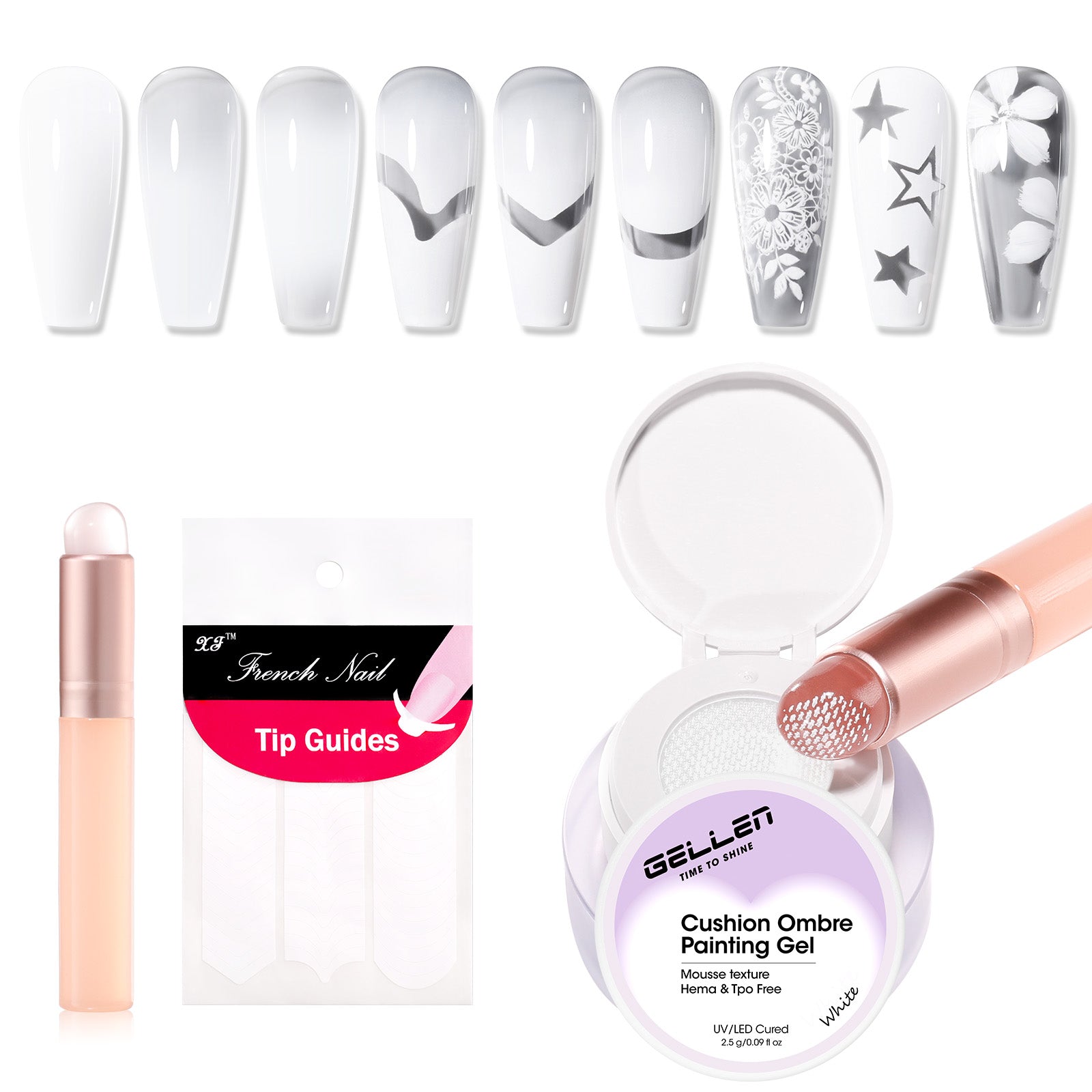
This is the method to start with. A silicone-tipped pen dabs rather than drags, which is exactly what a gradient needs — and the Gellen cushion ombre set comes with a double-head silicone pen and french tip stickers.
- Prep and base. Wipe the nail down, apply base coat, cure.
- Lay down the lighter colour over the whole nail. Cure.
- Apply the darker colour to the tip only. Roughly the top third is a good starting point — move the line higher or lower depending on how much fade you want. Do not cure.
- Dab along the border with the silicone pen, tapping straight down and lifting straight up. Do not sweep sideways; sweeping drags the colour into a smear instead of a fade.
- Work outward from the line in small taps until the transition softens. Stop as soon as the hard edge disappears — over-working it flattens the gradient into one muddy tone.
- Cure. Then repeat if you want the gradient deeper.
- Top coat and cure. Cap the free edge.

A double-head silicone pen gives you two tip shapes to work with: use whichever one fits the nail you are on. The french tip stickers in the same set are useful as a masking edge if you want a hard line somewhere and a fade everywhere else.
Method 2: makeup sponge
The classic method. Cheap, works with any gel polish, messier.
- Base coat, cure. Apply the lighter colour over the whole nail, cure.
- Paint both colours side by side onto a wedge sponge, overlapping slightly in the middle.
- Press the sponge onto the nail and lift straight off. Do not rub.
- Repeat, re-loading the sponge every single press, until the gradient builds up to the depth you want.
- Cure, then top coat and cure.
Two tips that make this method far less painful: tape or apply a peel-off barrier around the nail first — sponging is inherently messy — and re-load the sponge every single press, because a drying sponge deposits patchily.
Method 3: brush blending
Most control, longest learning curve. Lay both colours, then use a clean, slightly fanned brush to feather the border with light strokes perpendicular to the line. Wipe the brush between every pass — a loaded brush moves colour around instead of blending it.
Worth learning if you do a lot of nail art. Not where to start.
Which colours actually work together
The single biggest factor in whether ombre looks good is colour choice, not technique.
| Pairing | Result |
|---|---|
| Two shades of the same colour | Almost impossible to get wrong — best first attempt |
| Nude into a colour | Soft, wearable, hides an imperfect blend |
| Neighbouring colours (pink to coral, blue to teal) | Clean blends |
| White into any colour | Works, but white needs more coats to stay opaque |
| Opposite colours (red to green, orange to blue) | Muddy brown in the middle — avoid |
Fixing a blend you are not happy with
As long as you have not cured, you can fix it. Add a little more of whichever colour is under-represented and keep dabbing. If it has gone genuinely muddy, wipe the nail with cleanser and start that nail again — it is faster than fighting it.
Finishing
Ombre benefits from a slightly thicker top coat than usual, because the layered colour can leave a very slight ridge where the gradient sits. Glossy top coat keeps the colours saturated. Matte gives a softer, more diffuse gradient.
Shop the products in this guide
- Cushion Ombre Gel Polish with Double-Head Silicone Pen
- All gradient and ombre shades
- Glossy Top Coat 18ml
- Matte Top Coat 18ml
- Base Gel 18ml